
Tax on Etsy Sales UK: Do you need to pay? (UK Guide)
If you’re selling on Etsy and money is actually landing in your bank account, you’ve probably asked yourself the question every UK Etsy seller eventually asks: “Is there tax on Etsy sales in the UK? Do I owe HMRC anything?”
The honest answer is it depends – but the thresholds that decide it are simpler than most side hustle guides make out. This post covers everything you need to know about tax on Etsy sales in the UK –
|
This article covers everything UK sellers need to know: |
|---|
|
‣ The £1,000 trading allowance |
|
‣ When to register for Self Assessment |
|
‣ What counts as an allowable expense |
|
‣ Your Etsy fees and what they mean for reporting |
|
‣ VAT and when it becomes relevant |
|
‣ The records HMRC expects you to keep |
Turning a photography portfolio into an Etsy shop selling fine art prints is one of the most straightforward ways for photographers to build extra income from work already sitting on a hard drive. A growing shop means income, though, and that means your tax obligations deserve the same attention as your listings. Photography Biz Success helps photographers get their Etsy shop set up, priced, and selling properly. This post is about making sure HMRC isn’t a nasty surprise once it does.
This isn’t tax advice – just a clear breakdown based on my own research. Rules and personal circumstances vary, so always double-check with HMRC or a qualified accountant before acting on anything here.
Tax on Etsy sales UK: the £1,000 trading allowance explained

Want to turn your photography into income – without starting from scratch?
Want to build a photography business that works around you, selling prints on Etsy and shooting for stock libraries?
🤍 Practical advice tips for selling your photography online.
💙 Straight-talking advice from someone who’s been there.
Sign up below and start making progress today. 👇🏻
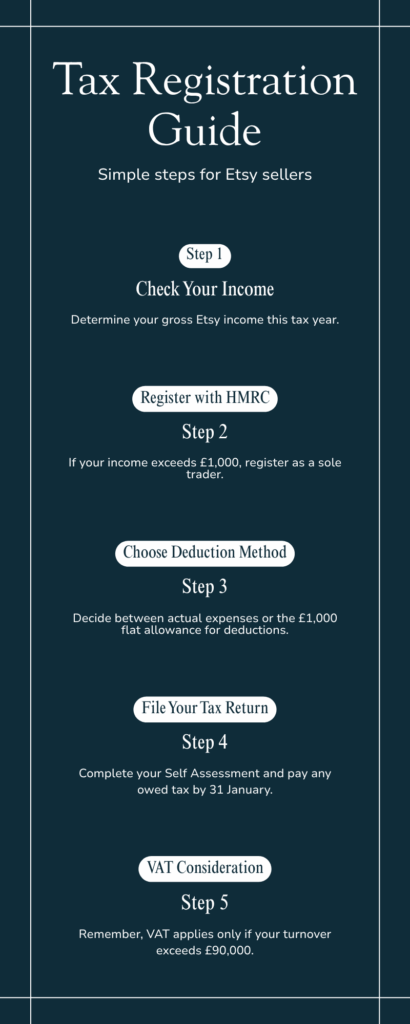
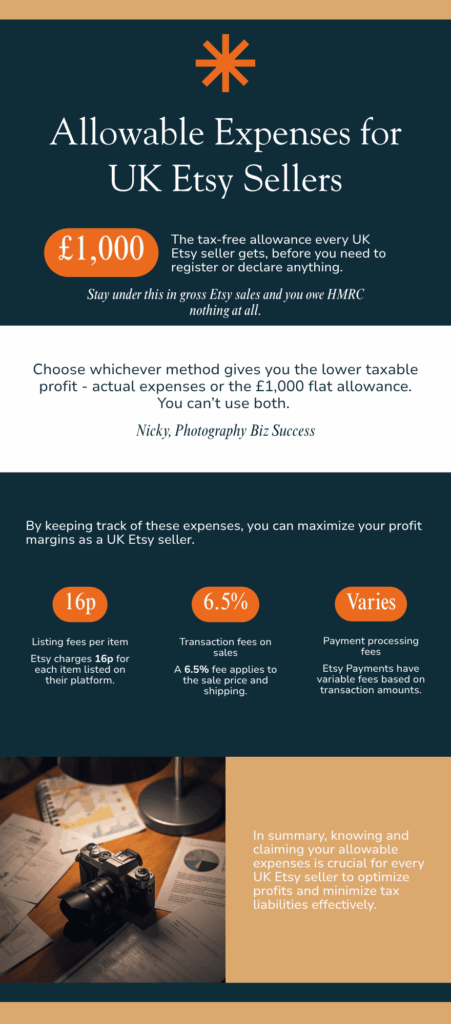
HMRC gives everyone a £1,000 tax-free trading allowance which runs from 6th April to 5th April (HMRC guidance on the Trading Allowance). Stay at or below £1,000 in total gross Etsy income, and that money is tax-free. No declaration, no registering with HMRC, nothing to do.
Here’s the key point that trips people up: gross sales count, not profit. Say buyers paid you £800 across the year, you’re under the threshold regardless of what you spent on materials, postage, or Etsy fees. Expenses don’t come into it at this stage.
One more thing worth knowing: the trading allowance covers all your self-made income combined, not just Etsy. Freelance work, client work, or another side hustle running alongside your shop gets added together with your Etsy sales when you check it against the £1,000 figure.
Tax on Etsy sales UK: when to register with HMRC as a sole trader
If you go over £1,000 gross Etsy sales in a tax year, you need to register with HMRC as a sole trader and file a self-assessment tax return. The deadline is 5th October following the end of the tax year you started trading in.
Registration deadlines and penalties
Miss the October deadline, and you risk a penalty. That penalty can sometimes be waived if any tax owed is paid by 31 January, but registering on time saves you the headache either way.
Filing tax returns follows a clear rhythm once you’re registered. Online returns, and any tax owed, are due by 31 January following the end of the tax year. So, income earned between 6 April 2025 and 5 April 2026 needs to be filed by 31 January 2027. Miss that date and it’s an automatic £100 fine, even if you don’t owe a penny.
Why Etsy’s reporting rules to HMRC matter
Online marketplaces like Etsy have been required to report seller information directly to HMRC since January 2024. The triggers are 30 or more sales in a calendar year, or roughly £1,700 in earnings. Being reported doesn’t automatically mean tax is due; if you’re under the £1,000 allowance, nothing is owed – but HMRC holds that data whether you’ve registered or not. Staying ahead of registration matters more because of this, not less.
-
How to become an Alamy Contributor: Step-by-step guide
How to Become an Alamy Contributor: Step-by-Step Guide To become an Alamy contributor, you create a contributor account and upload three test images to pass quality control. After that, you add a caption and at least five tags to each image. Your photos then go on sale within 24 hours. You need to be 18…

Income tax, National Insurance, and what you’ll actually pay
A lot of sellers panic unnecessarily here, so here’s the good news: income tax is charged on profit, not turnover. HMRC taxes what you keep after costs, not the full amount your buyers paid.
Your personal allowance and taxable profit
Your taxable profit gets added to any other income you have – a day job, client work, other freelance earnings, whatever else is coming in. Only the combined total above your personal allowance (currently frozen at £12,570 until at least April 2031) gets taxed. Most part-time Etsy sellers find they owe very little once this is factored in.
Class 2 or Class 4 National Insurance may also apply once profits pass certain thresholds, if your Etsy income tips you over into self-employed territory.
Worth knowing: your National Insurance record also affects your future state pension, so it’s not purely a cost to resent.
Two ways to calculate your taxable profit
HMRC gives you two options for working out taxable profit, and you pick whichever gives you the lower figure:
- Actual expenses – deduct your real allowable expenses (materials, Etsy fees, postage, packaging) from your turnover.
- The £1,000 flat allowance – deduct £1,000 instead of itemising anything.
You can’t use both. Two quick examples show why the choice matters:
- Turnover £1,500, expenses £200 → actual expenses give a profit of £1,300; the flat allowance gives £500. Flat allowance wins.
- For turnover of £3,000, expenses £2,400 → actual expenses give £600; the flat allowance gives £2,000. Actual expenses win, easily.
Tax on Etsy sales UK: Etsy fees, allowable expenses, and what counts as turnover
What counts as your taxable turnover
Your taxable turnover is everything the buyer paid you – the item price plus any shipping or gift-wrap charges. Etsy fees, payment processing charges, and any VAT Etsy collects on your behalf are not your income. Count them as business expenses, deducted from your revenue rather than added to it.
Eligible expenses you can claim
Going the actual-expenses route? Most Etsy sellers can claim:
- Listing fees (16p per item)
- Transaction fees (6.5% of the sale price plus buyer-paid shipping)
- Etsy Payments processing fees
- All Etsy Ads spend
- Currency conversion charges
- Materials and cost of goods – whether you’re selling handmade items, photos framed or canvas, handmade jewellery, vintage items, physical products, or digital downloads.
- Postage and packaging paid by you
- A reasonable share of home office costs.
Non-VAT registered sellers can also deduct the 20% VAT Etsy charges on its own fees, since there’s no other way to reclaim it.
Your Etsy account and monthly statements are your best friend here. They break down what buyers paid versus what Etsy deducted, and this maps cleanly onto self-assessment categories if you record it consistently. Build the habit of separating income from expenses at the point of each statement, rather than in a panic every January.
Tax on Etsy sales UK: when VAT becomes your responsibility
The VAT threshold
VAT registration only becomes compulsory once your total turnover goes over the VAT registration threshold – currently £90,000 in any rolling 12-month period. That figure is a long way off for most photographers selling prints on Etsy in the early and middle stages of building a shop, so there’s no obligation to charge VAT on domestic UK sales below it.
Cross-border orders and marketplace facilitator rules
Etsy acts as an online marketplace platform for cross-border orders. Under marketplace facilitator rules, it collects and remits VAT directly on qualifying orders, which takes that responsibility off individual sellers. This applies whether you’re selling from England, Scotland, Wales, or Northern Ireland – the rules work the same UK-wide, though Northern Ireland sellers should be aware of some extra EU-related VAT nuances if trading heavily into the EU. No VAT gets charged at the point of sale for most domestic sales from non-VAT-registered seller.
Some sellers voluntarily apply for a VAT number before hitting the threshold, usually to reclaim VAT on business costs. It can make sense for a high-volume Etsy business, but it brings regular VAT returns and more admin. For most early-stage sellers, it’s extra complexity without a real benefit. If your turnover is creeping toward £80,000, that’s your cue to speak to an accountant.
-
Why Email Marketing is Vital in Your Photography Business
Introduction: If you’re a photographer who doesn’t use email marketing to its fullest, this blog will show you why email marketing is vital in your photography business for growth. Social media often takes the spotlight when it comes to marketing your photography business, but email marketing is vital in your photography business. For photographers, building…
What if your shop grows into a limited company?
Most sellers operate as a sole trader, and for the average Etsy business, that’s the right call – simpler, with less admin. But a limited company structure becomes worth considering if your shop scales into serious money, since profits are then subject to corporation tax rather than income tax, and there can be tax-efficiency reasons to make the switch. This is very much a “speak to an accountant” decision, since it depends on various factors specific to your situation rather than a one-size-fits-all rule.
Records HMRC expects, and how long to keep them
HMRC expects records of your gross income, allowable business expenses (with receipts or invoices), and bank statements confirming the figures. Gross income means the total your buyers paid, not just what landed in your account after Etsy took its cut.
Keep everything for five years after the 31st January filing deadline for that tax year. Income earned in 2025/26, filed by 31st January 2027, needs records held until 31 January 2032. Digital copies are fine, as long as they’re legible.
A simple spreadsheet is genuinely enough for most sellers at this stage. Download your Etsy statements monthly, save your receipts, keep a running, detailed account of income and expenses by category, and reconcile against your bank statements once a quarter. Dedicated software isn’t necessary until your volume actually justifies it – a habit you’ll stick to beats a system you abandon by February.
Tax on Etsy sales UK: putting it all together
The decision tree for tax on Etsy sales in the UK isn’t as daunting as it first looks. Stay under £1,000 gross, and the trading allowance covers you completely. Go over £1,000, and you register as a sole trader by 5 October, choose your deduction method, and file by the following 31 January. VAT only becomes your responsibility past £90,000. HMRC now gets Etsy’s seller information directly; staying on top of this early beats HMRC knowing more about your shop than you do.
Building an Etsy print shop is one part creative, one part business. The creative side is why most of us start, but pricing, listings, traffic, and tax obligations are what turn the shop into a real income stream rather than an interesting experiment. Get clear on the numbers once, and it stops being something to dread every January.
Photography Biz Success offers free resources, shop and listing audits, and one-to-one mentoring if you’re building or growing a fine art print shop and want support that goes beyond the numbers, including helping to eventually build your own website too.
Your Etsy Tax Questions, sorted
Only once your gross Etsy income goes over £1,000 in a tax year. Below that, the trading allowance covers you, and there’s nothing to declare.
It depends on your total income and profit, not your total sales. Income tax only applies to profit above your personal allowance (£12,570), combined with any other income you have.
Not unless your total turnover passes £90,000 in a rolling 12-month period. Below that, domestic UK sales don’t need VAT charged on them
Materials, Etsy fees, postage, packaging, Etsy Ads spend, and a reasonable share of home office costs – or you can claim the flat £1,000 trading allowance instead, whichever gives you the lower taxable profit.
Yes. Since January 2024, Etsy has been required to report seller data to HMRC once you hit 30+ sales or around £1,700 in earnings in a calendar year, regardless of whether you’re registered.
Disclaimer: I’m a photographer and business mentor, not an accountant or tax advisor. This post is based on my own research and experience selling on Etsy – it’s meant to give you a clear starting point, not personalised tax advice. Tax rules change, and everyone’s circumstances are different, so please verify anything here against current HMRC guidance and check with a qualified accountant before making decisions about your own tax position.
If you’ve found this blog useful, why not check out my other blogs on becoming a successful stock photographer or building a fine art photography shop on Etsy?
Nicky x

Nicky is a UK-based photographer and business mentor with over 25 years behind the lens. Known for her straightforward approach to helping photographers turn their passion into profit, she is the founder of Photography Biz Success, with a strong focus on selling photography art and prints on Etsy and shooting for stock libraries.
Nicky’s work helps photographers build multiple income streams from their images, so their work stops sitting on a hard drive and starts generating income.

