How to Become an Alamy Contributor: Step-by-Step Guide
To become an Alamy contributor, you create a contributor account and upload three text images to pass quality control. After that, you add a caption and at least five tags to each image. Your photos then go on sale within 24 hours.
You need to be 18 or older. Alamy doesn’t charge a joining fee, and you can sell the same images on other sites too.
I went through the whole process myself in September 2026, and I took a screenshot of the process. So this guide shows you what you’ll see at each stage, in the order you’ll see it.
|
This article covers everything photographers need to know about becoming an Alamy contributor |
|
→ What you need before you sign up |
|
→ The five steps, with a screenshot of each screen |
|
→ Getting your first three images through quality control |
|
→ Captions, tags, licenses and releases |
|
→ What Alamy pays and when you get paid |
|
→ Why Etsy prints are a natural step |
Want to turn your photography into income – without starting from scratch?
Want to build a photography business that works around you, selling prints on Etsy and shooting for stock libraries?
🤍 Practical advice tips for selling your photography online.
💙 Straight-talking advice from someone who’s been there.
Sign up below and start making progress today. 👇🏻
What You Need Before You Become an Alamy Contributor
Do you already have a folder of sharp, well-exposed images on your hard drive? Then you have most of what you need. Before you sign up, check these five things:
- You are 18 or over, because Alamy’s contract requires it.
- You shoot on a mirrorless camera or a DSLR. Alamy also accepts photos from a main-brand smartphone released in 2020 or later.
- You have three strong images saved as JPEGs.
- Each file is over 17MB when you open it in your editing software.
- Your photos come from a real camera, because Alamy rejects AI-generate images.
Most compact and bridge cameras struggle to pass Alamy’s checks. So if you have a choice, use your main camera for your first upload.
|
Alamy Contributor facts at a glance |
|
|---|---|
|
Cost to join |
Free |
|
Minimum age |
18 |
|
Minimum file size |
Over 17MB uncompressed, which is a JPEG of about 3MB to 5MB |
|
First submission |
3 JPEG images with camera EXIF data |
|
Quality control result |
Usually within one working day |
|
Staring commission |
20% of direct sales (Silver tier) |
|
Payout threshold |
Over $75 in cleared funds |
|
AI-generated images |
Not accepted |
|
Exclusive? |
No. You can sell the same images elsewhere |
How to Become an Alamy Contributor in 5 Steps
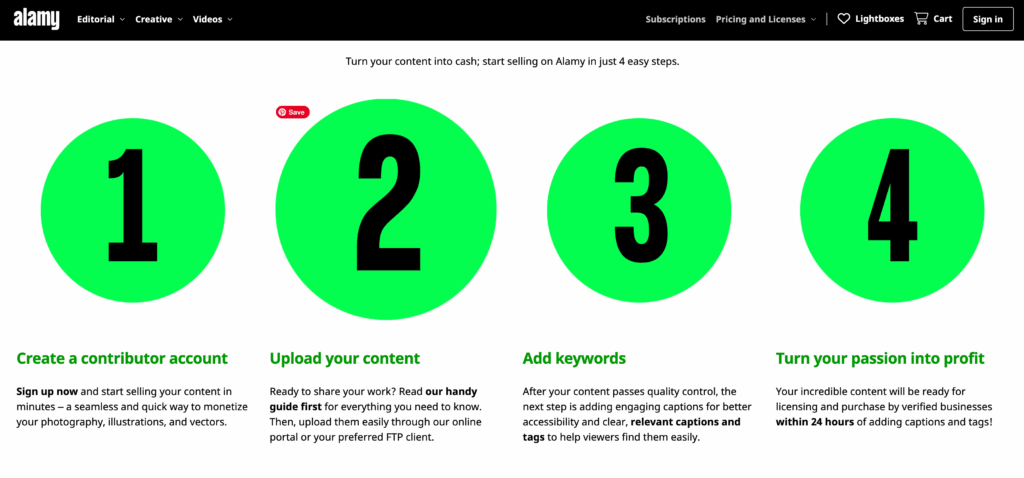
Alamy lists four steps on its own site. I’ve split them into five, because quality control deserves a step of its own.
Step 1: Create Your Contributor Account
First, go to Alamy’s contributor page and choose Sign up. The form is one page, and Alamy asks for:
- First and last name
- Email address and a password
- Phone number
- Address
- Whether you are a photographer, an agency or a student
- An optional About you section for your website and social links
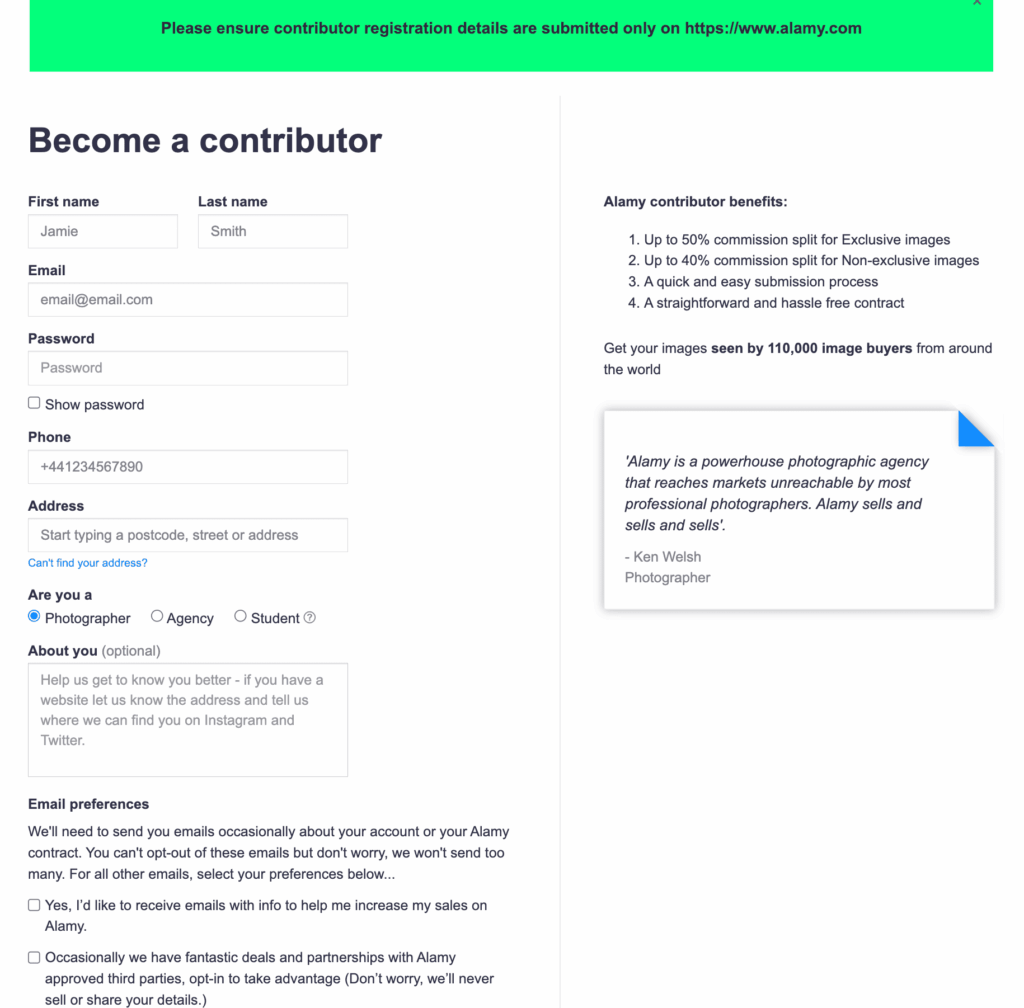
Use your full legal name and your current address, because Alamy’s contract asks for both. You can still sell under a different name later. Alamy calls that name a pseudonym.
Look at the benefits list on the right of the form. It promises up to 40% commission for non-exclusive images. The key words are “up to”. Since 1 September 2026, new contributors start at 20%. I explain the tiers further down.
Are you a student? Then tick Student, because Alamy pays students 100% of direct sales for two years.
Once you submit the form, you land on a thank-you screen.
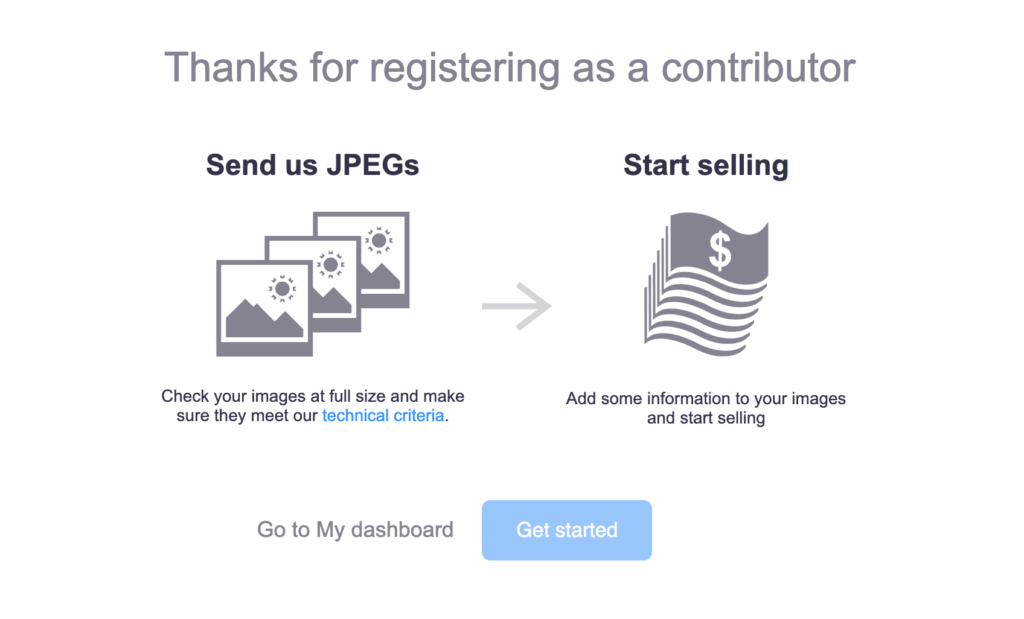
Before you move on, add your payment details in Account Settings. Alamy pays by PayPal or bank transfer, in GBP, USD or EUR. Alamy also asks for a payment reminder, such as “my current account”. Once you save them, your bank details stay hidden, so the reminder tells you which account you chose.
-
How to Sell Stock Photography and Earn Passive Income
How to Sell Stock Photography and Earn Passive Income Here’s how to sell stock photography in short: choose two or three stock agencies, prepare your images to their individual technical standards, and keyword them the way buyers actually search. Sort your releases, then submit consistently every week/month. Do that and your existing photos start earning…
Step 2: Prepare Your First Three Images
Your first upload is a test. Alamy wants three of your best images, and every one must pass.
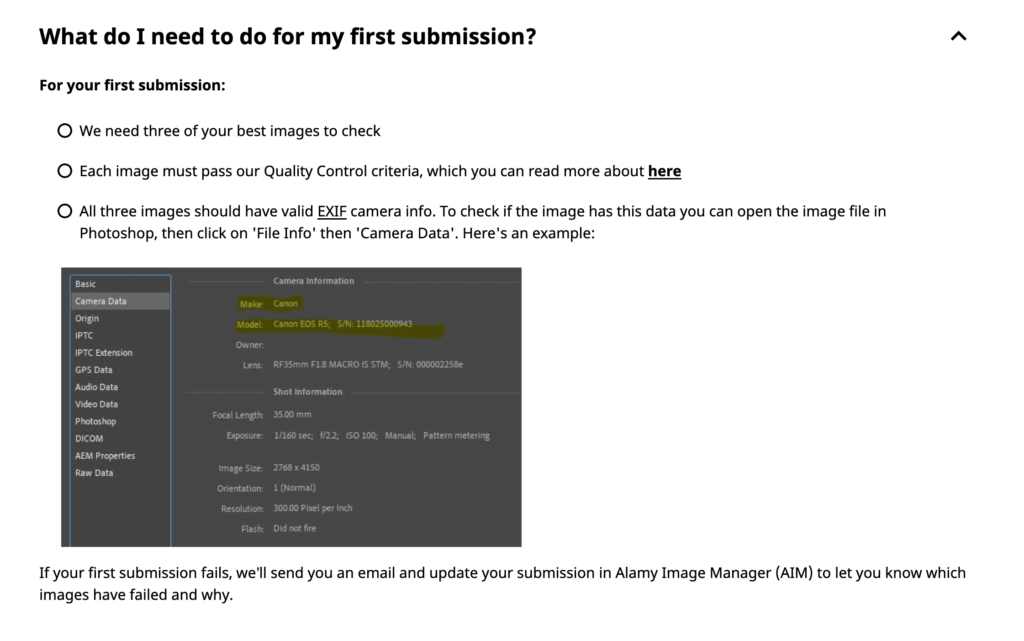
Each image needs valid EXIF camera data, because Alamy uses it to check your camera. So export from your original files and keep the metadata switched on.
The 17MB rule confuses a lot of photographers. It refers to the open, uncompressed size, not the JPEG size on your disk. A JPEG of 3MB to 5MB usually meets it. In practice, an image of 3000 by 2000 pixels or larger clears it.
Next, open each image at 100% and look for these problems.
- Soft focus or camera shake
- Noise, which shows up at high ISO
- Dust spots
- A colour cast or poor exposure
- Added sharpening, because Alamy asks for none
Alamy’s guide to passing quality control shows an example of each fault.
AI editing tools need care. Alamy accepts edits that copy standard retouching, such as denoising. But Generative Fill, or anything that changes the reality of the scene, can fail.
For my test, I chose three simple subjects. They were a wood grain pattern, a turntable stylus and a Union Jack Flag on a fence post. None of them included people, so I didn’t need a release. Each of them showed the type of photography I take.
Step 3: Upload Your Test Submission
Click Get Started on the thank you screen. Alamy then asks what you are uploading. Choose Photograph under Stock, then click next
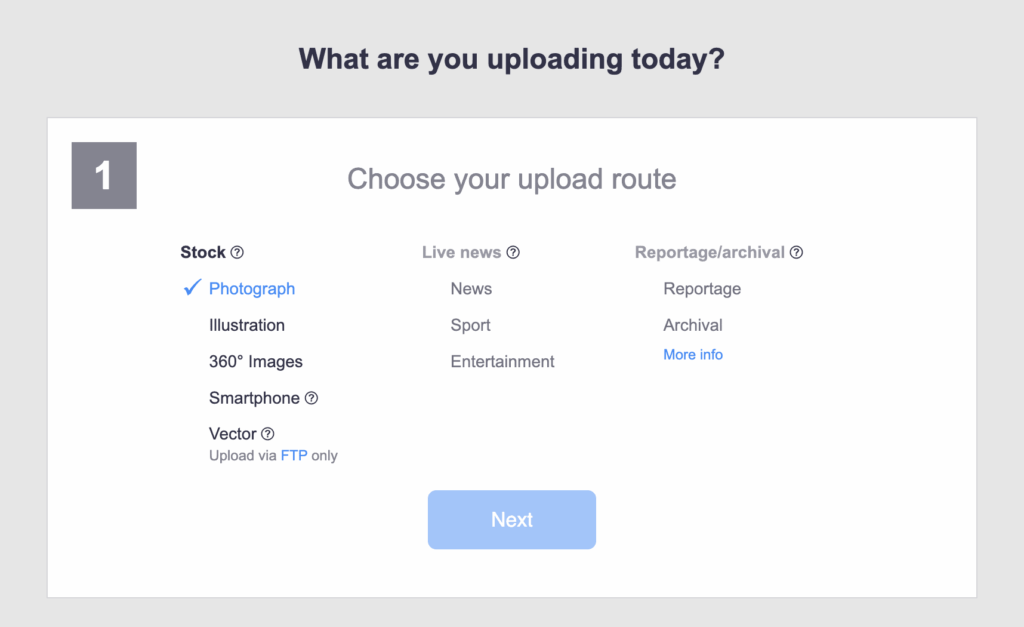
You’ll also see routes for illustrations, 360° images, smartphone photos and vectors. Vectors go through FTP only. Live news and reportage have their own routes and their own rules, so leave those for now.
Then add your three JPEGs and click submit. Alamy confirms the upload and moves you to quality control.
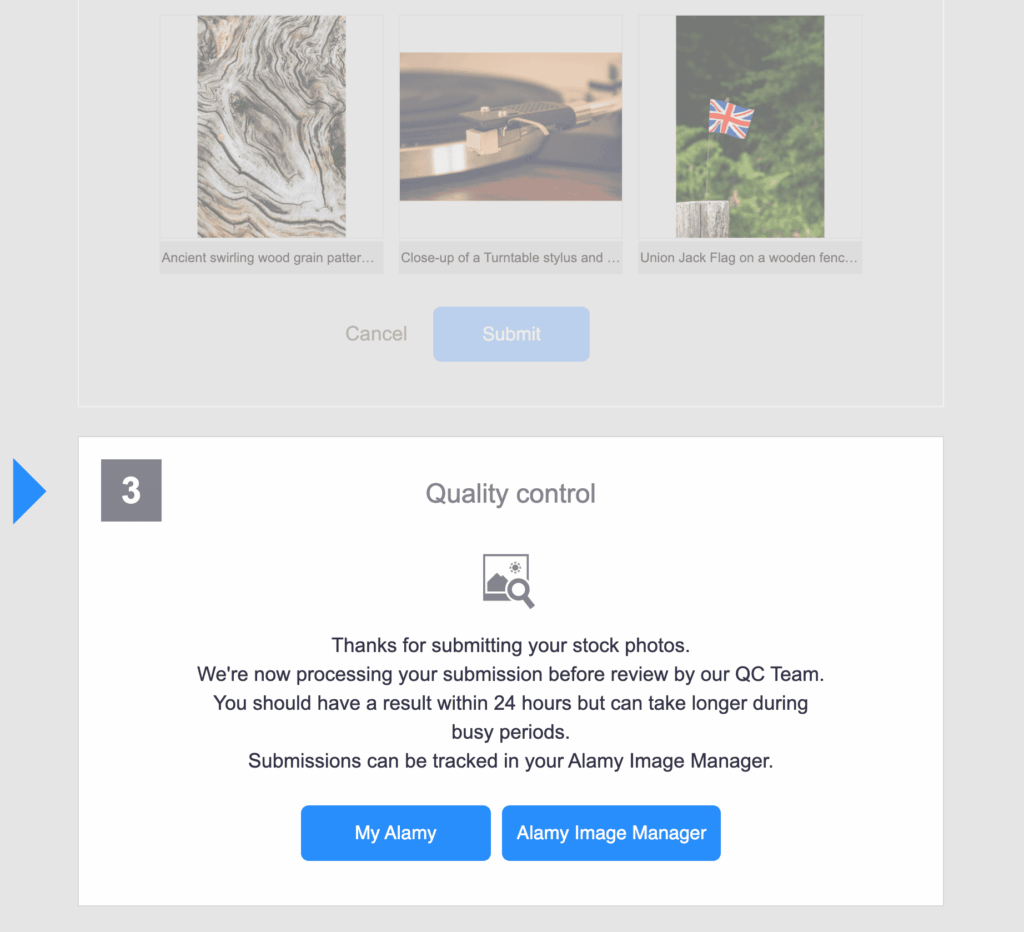
The screen says you should have a result within 24 hours. It can take longer in busy periods. Alamy’s quality control team works Monday to Friday, so a weekend upload waits until the following week.
Step 4: Pass Quality Control
Alamy emails you as soon as the team has checked your images. Your submission also updates inside Alamy Image Manager.
I uploaded my 3 initial images for QC on a Friday afternoon. By Monday lunchtime, I had received an email to say I had been successful.
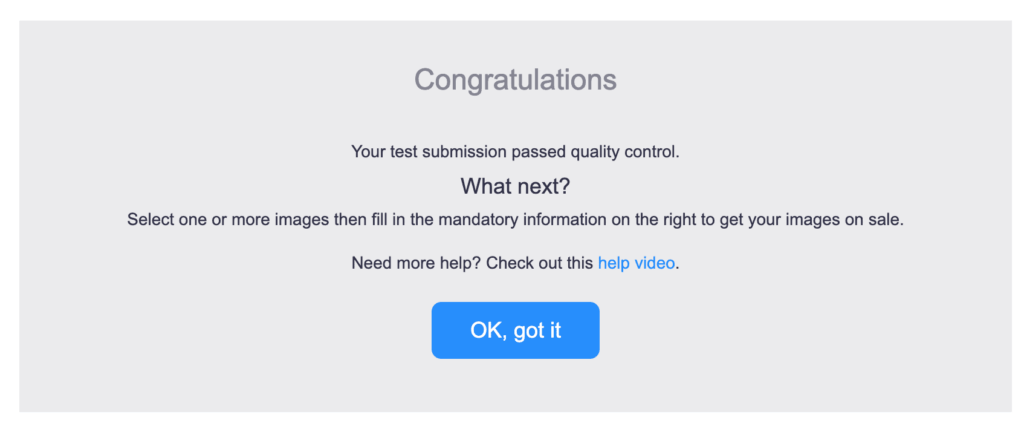
If your test fails, Alamy tells you which images failed and why. Fix those problems first, then submit again.
After your test, the checks work differently. Alamy looks at a random sample from each submission. If one image in that sample fails, every image waiting in quality control fails. So check every file at 100% before you upload, not just your favourites.
Your dashboard also shows a QC rank from one to five stars. The more often you pass, the faster Alamy checks your work.
Step 5: Add Captions and Tags to Put Your Images on Sale
Passing quality control doesn’t put your images on sale. First, you need to fill in the Mandatory tab in Alamy Image Manager.
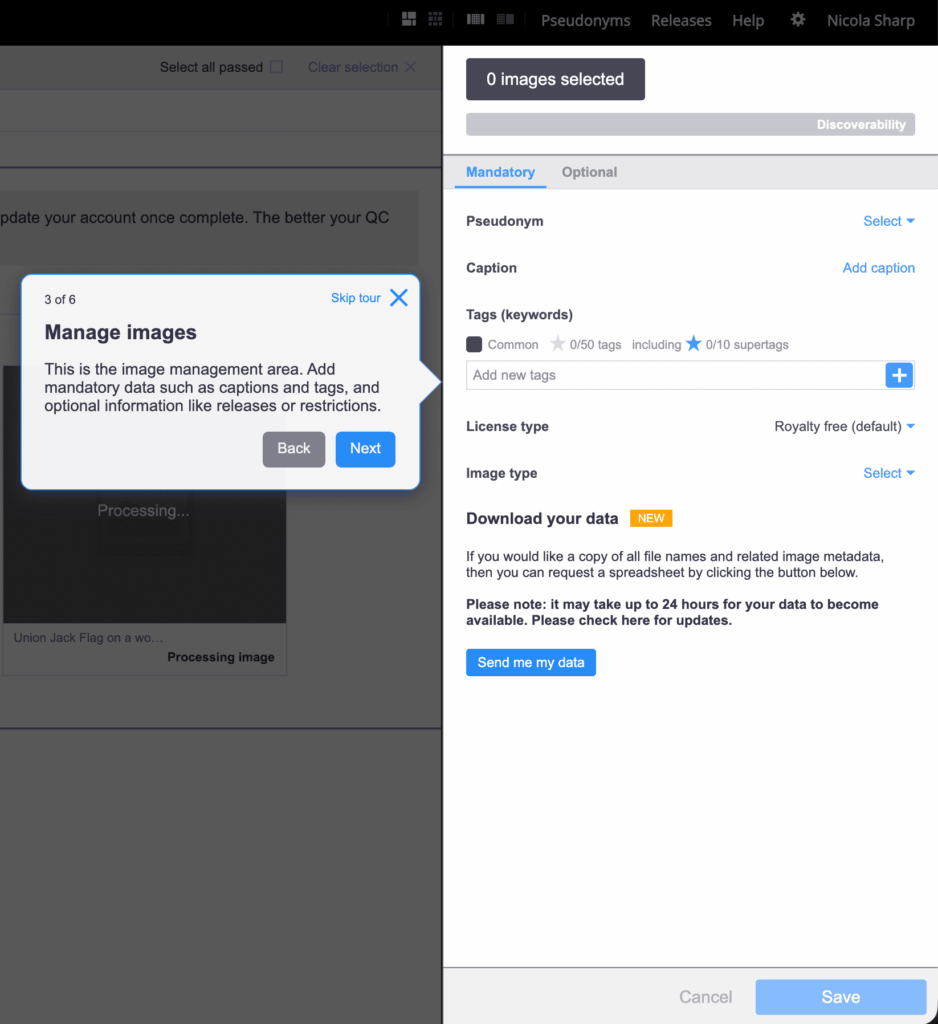
- Pseudonym: the name buyers use to credit you
- Caption: one clear sentence that says what, where and when. Write it in English
- Tags: at least 5 and up to 50. You can also mark up to 10 of them as supertags.
- Licence type: Alamy sets Royalty-free as the default
- Image type: pick the option that matches your file.
The discoverability bar rises as you add more information. But it measures volume, not quality. So ten accurate tags beat fifty loose ones.
For example, this caption and tag set suit my flag image:
- Caption: Union Jack flag on a wooden fence post in front of green ferns
- Tags: union jack, british flag, flag, fence post, ferns, green foliage, united kingdom. patriotism, national identity, outdoors.
- Supertags: union jack, british flag.
Did you upload a set from one set? Then select the whole set and add the shared caption and tags in one go.
Once you save a caption and five tags, your images go on sale within 24 hours. That is how long Alamy’s search takes to update.
Licences and Releases: Which Should You Choose?
Alamy gives you two licence types:
- Royalty-free (RF): the buyer pays once and can use the image across projects, with no time limit.
- Rights managed (RM): the buyer pays for one specific use, such as a single print run or territory.
Alamy recommends RF because buyers ask for broad rights. Keep similar images on the same licence type. Also match the licence type you use for that image on other agencies, because the contract requires it.
Releases depend on what is in the frame.
- People or recognisable property with a signed release: buyers can use the image commercially.
- People or recognisable property with no release: Alamy sells the image for editorial use only.
You don’t upload the release. Instead, you mark the image as released and keep the paperwork, because Alamy may ask for it later.
What Alamy Pays Contributors
Alamy changes its commission structure on 1 September 2026. As a result, many guides online still quote the old figures. These are the current tiers for direct sales:
|
Tier |
Your share |
Your gross sales in revenue year |
|---|---|---|
|
Bronze |
15% |
Under $250 |
|
Silver |
20% |
$250 to $3,000 |
|
Gold |
40% |
Over $3,000 and up to $25,000 |
|
Platinum |
50% |
Over $25,000, with image exclusivity to Alamy |
New contributors start on Silver, so you earn 20% of each direct sale. Alamy’s revenue year runs from 1 September to 31 August. You stay on Silver for the rest of the year you join. After that, Alamy reviews your sales every year. If you sell under $250 in a full year, you drop to Bronze.
What does that look like for one sale? Alamy says its average licence price is $35. At 20%, that is $7 to you. Sales through distributors and affiliates pay less, because a partner takes a cut first.
Payment works like this:
- Alamy pays monthly once you have over $75 in cleared funds.
- Cleared means the buyer has paid Alamy. That takes 45 days to 4 months, or up to 6 months for distributor sales.
- Alamy starts the payment run on the first working day of the month. The money can take up to nine working days to arrive.
- Alamy doesn’t send tax forms. You declare the income yourself, so keep a record for your Self Assessment.
- Are you VAT registered in the UK? Then add your VAT number, and Alamy sends a self-billing invoice with each payment.
So your first payout takes some time. At that average, you need eleven direct sales to pass $75.
Is It Worth It to Become an Alamy Contributor?
That depends on what you expect. A 20% starting rate is low, and sales build slowly. But the risk is low too:
- You keep your copyright
- Alamy is non-exclusive, so you can upload the same images to other agencies.
- Leaving takes 45 days’ written notice.
- Joining is free
Alamy describes its collection as encyclopaedic. It sells to publishers, news desks, designers and marketers. So it wants specialist subjects as well as mainstream ones: named locations, everyday objects and niche topics.
I treat Alamy as one agency in a small group, not as the whole plan. My guide on how to sell stock photography compares the main platforms. I’ve also covered the Shutterstock contributor requirements, in case you want a second agency.
Why Etsy Prints Are a Natural Next Step
Stock pays you a share of a licence fee, and Alamy sets the price. A print works the other way round. You set the price, and you keep what is left after your costs.
The two don’t compete. Alamy’s contract says print sales and your own website don’t affect exclusivity, So one image can earn a licence fee on Alamy and also sell as a print on Etsy.
Take my wood grain image, for example. On Alamy, a designer might license it as a background. On Etsy, the same file could sell as wall art for a living room.
Do you want to add prints alongside your stock portfolio? Then start with my free Etsy resources for photographers.
Frequently Asked Questions
Yes. Alamy doesn’t charge you to register or to upload. Instead, Alamy takes its share as a commission when one of your images sells.
Registration is one form. Alamy usually checks your three test images within one working day. After you add captions and tags, your images go on sale within 24 hours.
New contributors start on Silver and earn 20% of direct sales. The tiers run from 15% on Bronze to 40% on Gold. Platinum pays 50% on exclusive images once you pass $25,000 in yearly sales.
No. Alamy is a non-exclusive agency, so you can sell the same images on other stock sites. Exclusivity only changes your commission at Platinum level.
Yes. Alamy accepts most photos from a main-brand smartphone released in 2020 or later. Choose the Smartphone route on the upload page. You then add captions and tags on a laptop or desktop.
No. Alamy rejects images that AI has generated in whole or in part, and it removes any it finds. You can still use AI tools that copy standard retouching, such as denoising.
Alamy emails you and updates your submission in Alamy Image Manager. You’ll see which images failed and why, so you can fix them before you try again.
Ready to Become an Alamy Contributor?
Pick your three sharpest images this week. Then check each one at 100%, export them as JPEGs and create your account. You could have your result within a day.
Do you want help with what to shoot and upload after that? My free stock photography resources are the place to go. When you’re ready for more, the Start-to-Scale Stock Photography System takes you further.
Nicky x

Nicky is a UK-based photographer and business mentor with over 25 years behind the lens. Known for her straightforward approach to helping photographers turn their passion into profit, she is the founder of Photography Biz Success, with a strong focus on selling photography art and prints on Etsy and shooting for stock libraries.
Nicky’s work helps photographers build multiple income streams from their images, so their work stops sitting on a hard drive and starts generating income.

